Traditional
Painted finish
Warm Neutral
Putty — Warm Shaker
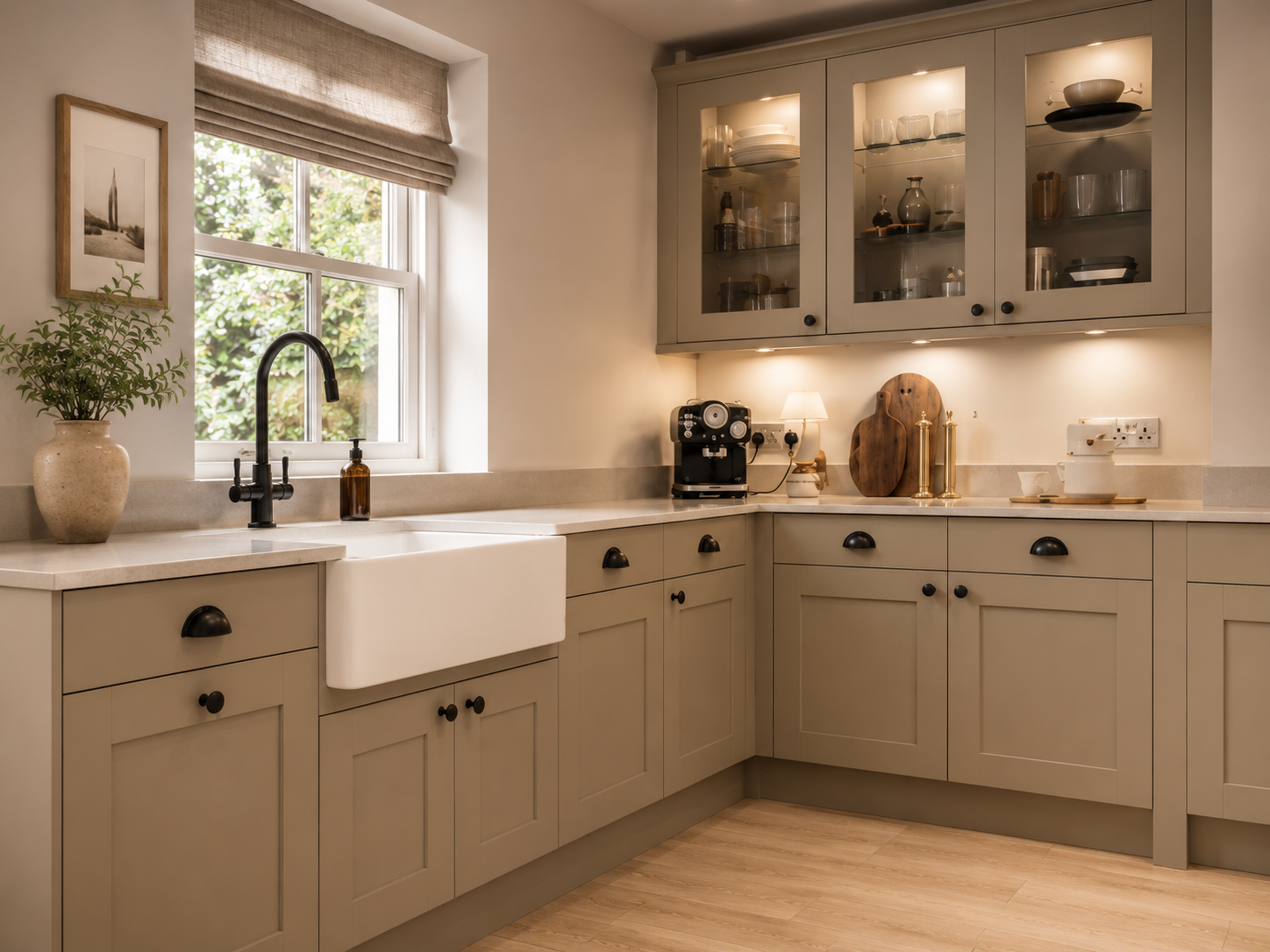
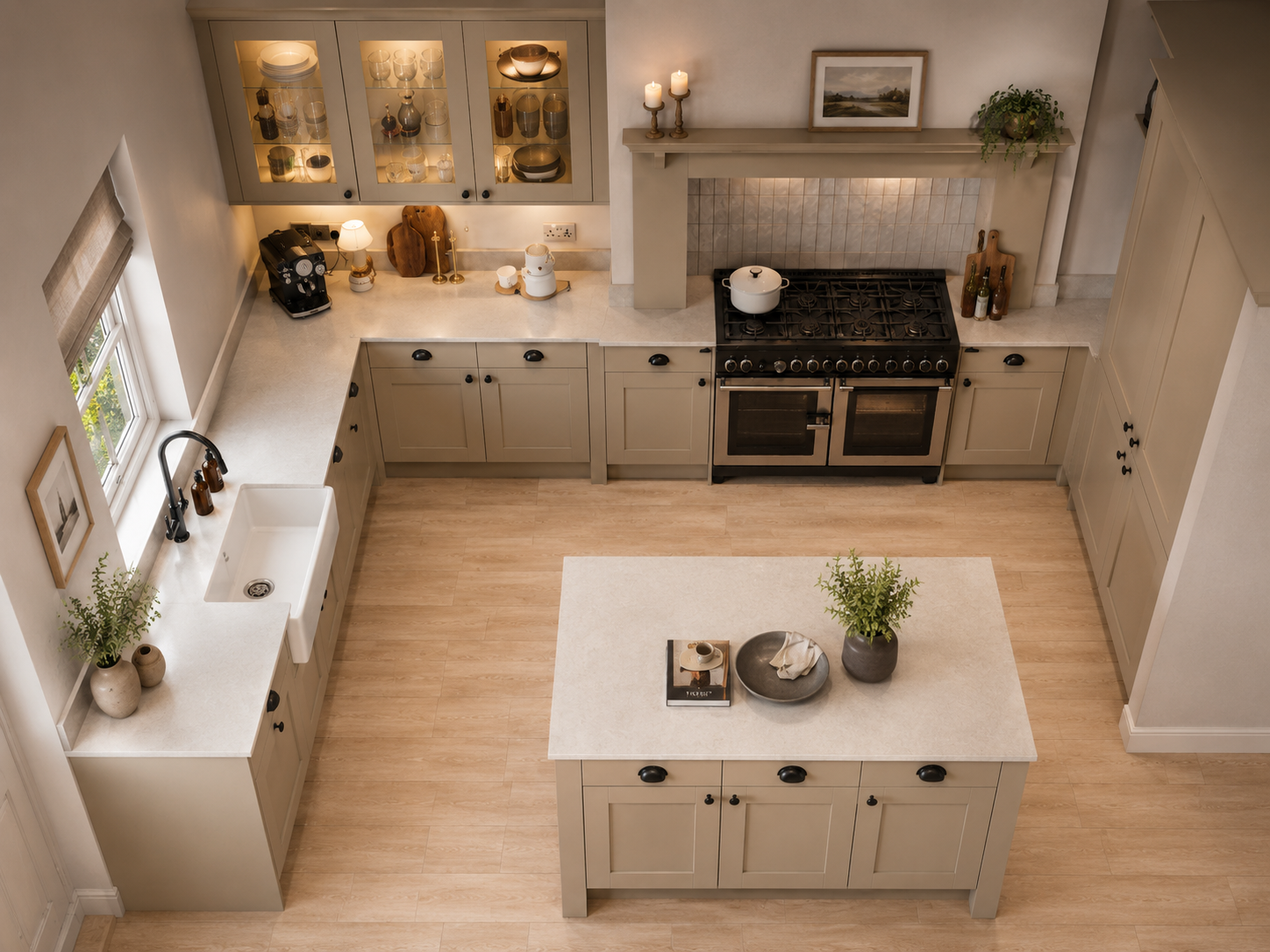
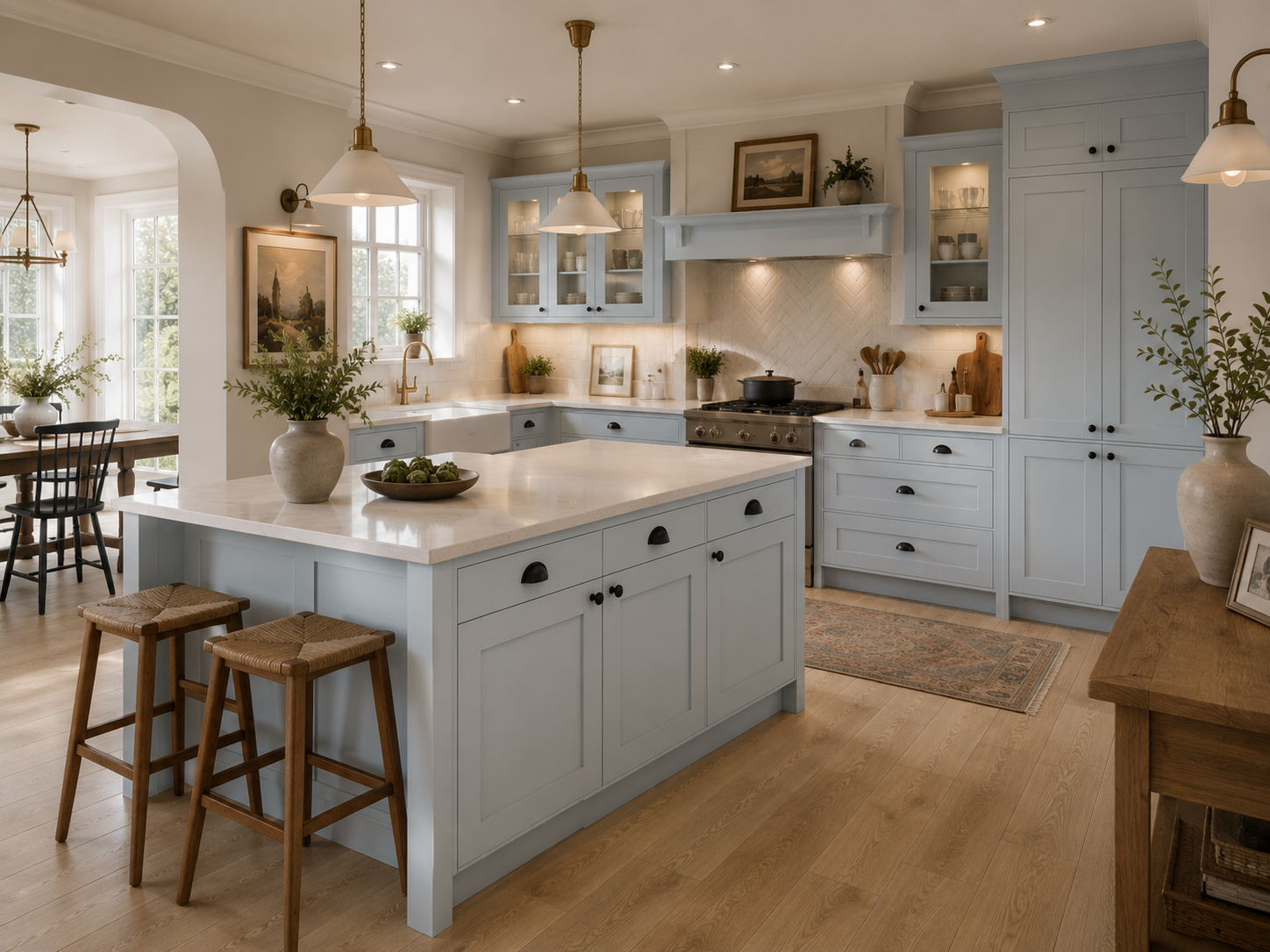
a putty-painted traditional kitchen with a Belfast sink, hand-finished in London
Warm putty paint, a deep Belfast sink and glazed dressers that hold china rather than décor. A traditional kitchen drawn without a single |nostalgic cliché|.
— Specification
- Collection
- XVII — Putty — Warm Shaker
- Style
- Traditional
- Door style
- In-frame shaker with cock-beaded drawer fronts
- Paint
- Warm putty, five-coat hand-sprayed eggshell
- Sink
- Deep fireclay Belfast with hand-grooved drainer
- Feature joinery
- Glazed dresser with painted interior
- Standard worktop
- 30 mm honed stone or solid timber
- Typical footprint
- 16–32 m²
- Lead time
- Four weeks from signed drawings
- Installation
- 3–5 working days, in-house fitting team
The most forgiving colour we paint
Putty is a warm grey-beige that sits between stone and mushroom. It reads as a neutral but has enough pigment to give painted joinery depth, and it works with almost every flooring, stone and metal we specify — which makes it the safest choice in a period house full of existing materials.
In practice it is the colour we recommend when a client loves several different schemes and cannot choose between them. German cabinetry, |hand-finished in London| by one team.
Traditional construction, current engineering
The joinery is traditionally proportioned: in-frame doors, cock-beaded drawer fronts, a plate rack over the sink and a freestanding-feeling dresser. Behind the elevations everything is current — Blum motion, 70 kg runners, adjustable hinges and moisture-resistant carcasses.
That combination is the point of a bespoke maker: a kitchen that looks like it has always been in the house and works like it was made this year.
The Belfast sink and the working wall
A deep fireclay Belfast sink is set under the window with a solid timber or stone drainer grooved by hand. It is the single most practical fitting in a traditional kitchen — large enough for roasting trays that will not fit in any undermount bowl.
Either side, deep pan drawers and a dishwasher concealed behind a matched door keep the working wall calm.
Dressers, larders and the display question
Glazed dressers are drawn to hold everyday china rather than ornaments, with painted interiors and adjustable solid timber shelves. A walk-in or pull-out larder handles dry goods, keeping the wall run free of cluttered cupboards.
The result is a kitchen with visible storage that still looks ordered on a Wednesday evening.
— The kitchen in detail
What this kitchen is made of.
- Putty-painted joineryWarm grey-beige that works alongside almost any existing material.
- Fireclay Belfast sinkDeep enough for roasting trays; paired with a hand-grooved drainer.
- Honed stone worktopMatte surface that suits a traditional elevation better than polish.
- Solid timber shelvingAdjustable dresser shelves in oak or painted tulipwood.
- Warm timber flooringBoard or parquet, oiled rather than lacquered.
Bring the Putty — Warm Shaker kitchen into your home.
Request a QuoteNothing here is fixed.
Every kitchen we build is drawn to a specific room and a specific way of cooking. These are the modifications clients most often make to this model — the list is not exhaustive.
Colour and paint
Putty as standard, with the full colour library available.
- Any Farrow & Ball, Little Greene or Paint & Paper Library colour
- Mushroom, bone, stone, sage or olive alternatives
- Contrasting dresser or island colour
- Hand-rubbed or distressed finish for older properties
Sink, tap and worktop
Traditional fittings specified for daily use rather than appearance.
- Single or double fireclay Belfast, or an undermount stainless bowl
- Perrin & Rowe bridge mixer, or a Quooker instant-boiling tap
- Honed stone, solid timber or a combination of both
- Hand-grooved timber or stone drainer
Traditional joinery features
The details that make a kitchen read as period rather than fitted.
- Glazed dresser, plate rack and open shelving
- Walk-in or pull-out larder with spice racking
- Range cooker recess with a brick or stone surround
- Boot room, pantry and utility in matched paint
- Window seat and bench joinery
How a Putty — Warm Shaker kitchen gets built.
- 01Consultation & surveyWeek 1On-site measure, brief, lifestyle and cooking audit.
- 02Design & technical drawingsWeek 2Elevations, renders, samples, services and appliance schedule signed off.
- 03Workshop buildWeek 3German cabinetry, hand-finished in our London workshop. Dry-assembled before it leaves us.
- 04Installation & stoneWeek 4Our own fitters — |never subcontracted| — set the kitchen, then worktops are templated, fitted and calibrated.
- Period cottages, farmhouses and Victorian terraces in Notting Hill and Primrose Hill
- Listed and conservation-area properties
- Homes with existing flooring, tile or stone that must be worked around
- Clients who want traditional character without a themed kitchen
Asked often.
Is putty too safe a colour?
It is the most flexible one we paint. If you want more presence we usually keep the perimeter in putty and take the island somewhere stronger — olive, ink or oxblood.
Is a Belfast sink practical?
Very. It handles roasting trays and large pans that no undermount bowl will take. The trade-off is a slightly higher splash rate, which the drainer detail manages.
How much does a putty shaker kitchen cost in London?
Most projects fall between £32,000 and £80,000 fitted, including cabinetry, worktops, sink, hardware and installation. No middlemen.
Will it suit a listed building?
Yes — this is the collection we most often specify in conservation areas, because it can be scribed to uneven walls and drawn in traditional proportions.
— Other kitchens you may like
Start your own Putty — Warm Shaker.
Direct from the manufacturer — designed, built and fitted by Dominus Kitchens for private homes across Greater London and the UK.